A strange fact about elder care and healthy longevity
A nightlight can be a handrail for the eyes
A dim outline around a doorway — not a brighter room — improved standing performance in a controlled test. In a small randomised crossover trial among 38 residents with dementia, the same idea was associated with 34% fewer nighttime falls than standard nightlights, although the result was not statistically conclusive.
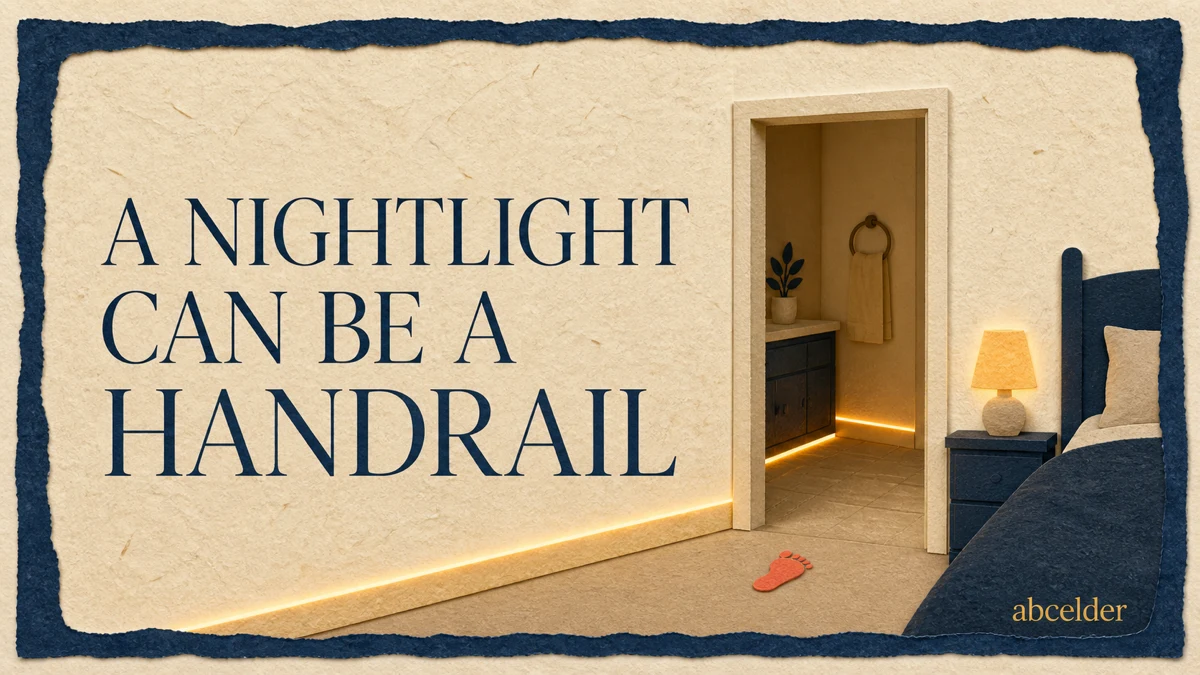
Most home-safety advice treats a nightlight as a miniature sun: add enough illumination to reveal the rug, the threshold and the chair leg. That matters. But vision is also part of the balance system. It tells the brain where the body is relative to a stable world.
When someone sits up in darkness, stands and looks towards the bathroom, a small pool of light near an outlet may show the floor without making the room's geometry easy to read. A visible vertical and horizontal frame can supply something different: a fixed reference for upright, distance and destination.
Calling that reference a ‘handrail for the eyes’ is a metaphor, not a medical claim. The strange fact underneath it is measurable: at the same very low ambient light level, changing the shape and position of light changed how people transferred their weight and moved. Brightness was not the only active ingredient.
The useful part was not more light
A controlled study recruited 48 adults aged 65+ and compared three conditions during a sit-to-stand task. One was bright ceiling light, about 650 lux at the eye. One used conventional plug-in nightlights at no more than 0.015 lux. The third stayed at the same very low ambient level but added self-luminous horizontal and vertical lines around a simulated doorway.
The researchers measured weight-transfer time: the interval needed to move the centre of gravity forward from sitting into standing. Across participants, the average was 0.84 seconds with conventional nightlights and 0.67 seconds with the horizontal-and-vertical cues — essentially the same as under bright ceiling light. Among participants classified as fallers, it was 1.30 seconds with conventional nightlights and 0.96 seconds with the line cues.
That does not mean a fraction of a second predicts whether a particular person will fall. It is a laboratory measure, not an injury outcome. The study also used different seat heights for the faller and non-faller groups, and everyone repeated the task. What it demonstrates more cleanly is that two dim environments with similar illumination can produce different postural behaviour because one contains stronger spatial information.
A doorway became balance information
The idea later moved into five assisted-living communities. Thirty-eight ambulatory residents with dementia, mean age 85, entered a randomised crossover feasibility trial. During the intervention condition, amber LED strips traced the top and sides of the bathroom or entry doorway facing the bed. A lip hid the LEDs from direct view to limit glare, and the system delivered no more than 0.5 lux at the eye from two metres. The control condition used one standard nightlight in the bedroom and one in the bathroom.
Infrared cameras provided usable observations for 7,875 nights. Researchers saw 61 falls during control nights and 31 during intervention nights. After adjustment for community and study period, the estimated fall rate was 34% lower with the doorway lighting: incidence density ratio 0.66.
The confidence interval ran from 0.35 to 1.22 and crossed no effect; p was 0.18. In plain English, the study was too small and variable to rule out chance. One resident had 34 falls, COVID-19 shortened the planned follow-up, and the full three-sided light was operating on only about three quarters of recorded intervention nights. This is a promising signal from a pilot, not proof that illuminated doorframes prevent falls.
Still, the intervention was more specific than ‘add a nightlight’. It held brightness low, reduced direct glare and made the destination's vertical and horizontal structure visible from the bed. The product was not just light. It was orientation.
What ‘make it brighter’ misses
Official fall-prevention guidance is right to recommend good lighting, accessible switches and automatic nightlights. A dark route with invisible obstacles is hazardous. The missed variable is whether the light describes the route from the person's actual viewpoint.
A bright source can sit behind the walker, create glare, flatten a threshold or leave the destination as a dark rectangle. A low outlet light can mark its own location without showing which opening leads to the bathroom. More lumens do not automatically create a stable visual reference.
This changes the design brief. For a family, the question becomes: from the edge of the bed, can the person immediately identify a safe direction, a doorway and the floor boundary without looking into a bare bulb? For a care setting, lighting should be tested after dark from resident eye height, not approved from a reflected-light number on a plan. For a product team, success is not only illuminance. It includes cue placement, glare shielding, activation timing, failure behaviour and whether the route remains readable when furniture, doors or mobility aids move.
The same cue will not suit everyone. Visual impairment, hallucinations, migraine, sleep disturbance, room layout and personal preference can change the response. A glowing frame may orient one person and irritate or confuse another. The point is to test geometry, not to prescribe a universal strip of LEDs.
Design the first ten seconds
Nighttime mobility is often discussed as a complete journey from bed to bathroom. The first ten seconds contain several different problems: waking, finding the destination, moving from lying to sitting, placing the feet, standing, and only then walking. A light near the toilet cannot help much if the difficult moment happens before the doorway is visually organised.
This is why destination-based cues are interesting. In a separate pilot with 15 community-dwelling adults over 75, participants repeatedly walked from a bed to a bathroom under their usual nightlight and under an LED strip condition. The destination cues shortened walking time and changed gait and trunk measures, including smoother trunk movement. Again, this was a small controlled study, not evidence of fewer injuries at home. It supports the mechanism: the visible destination can change the movement strategy.
The practical shift is modest. Before buying a brighter bulb, watch the route as a sequence. Where does orientation fail? Is the problem seeing an obstacle, finding upright, locating the doorway, judging a threshold, or reaching a switch? Different failures need different fixes. A motion-sensor light, a shielded low-level cue, contrast on a real edge, furniture removal, a bedside rail or professional assessment are not interchangeable products.
Audit the first ten seconds
Choose one ordinary evening when the person is alert and willing. Do not ask them to walk in darkness for a test:
- 1 Turn on the existing night setup, then sit at the person's usual eye height on the edge of the bed. Look towards the destination. Can you identify the doorway, floor direction and any real level change without seeing a bare light source?
- 2 Ask one functional question: ‘What is the first thing that is hard to find or judge when you get up?’ Do not substitute your view of the room for theirs.
- 3 Change one reversible variable without reducing existing safety: reposition an existing automatic nightlight so it reveals the destination, shield direct glare, or keep the bathroom door in the position the person finds easiest to recognise. Never run loose cables across the route.
- 4 Check the view again from sitting and standing. If there have been falls, near-falls, dizziness, new visual symptoms or confusion, preserve the details and involve an appropriate clinician or occupational therapist rather than treating lighting as the whole explanation.
This is an observation exercise, not a fall-prevention treatment. Do not copy a research lighting system as a substitute for an individual falls, vision, medication or home-safety assessment.
How much confidence should we place in this?
Confidence is moderate that stable horizontal and vertical light cues can change short-term postural and gait measures in controlled conditions. The 48-person repeated-measures study found shorter weight-transfer time, and the 15-person destination-cue pilot found changes in walking performance. Both measured human movement, but both were small and laboratory-like.
Confidence is low that the doorway lighting prevents falls. The 38-person randomised crossover pilot recorded fewer falls with the intervention, but its adjusted estimate was not statistically conclusive, the sample was narrow, equipment was not always fully operational and the study took place in assisted-living dementia units rather than private homes. A larger trial is needed.
Confidence is high only in the practical observation that ‘more light’ and ‘more usable visual information’ are not identical design goals. The safe next move is to inspect the real route with the person, preserve glare control and existing safety, and treat lighting as one part of a wider falls assessment.
Sources
- 1. Feasibility of a Novel Lighting System to Reduce Nighttime Falls in Assisted Living Residents With Dementia — Journal of the American Medical Directors Association, 2024. Randomised crossover feasibility trial in 38 residents; the adjusted 34% reduction did not reach statistical significance.
- 2. Lighting for improving balance in older adults with and without risk for falls — Age and Ageing, 2012. Controlled 48-person study of bright light, conventional nightlights and dim horizontal/vertical cues during sit-to-stand.
- 3. Impact of destination-based visual cues on gait characteristics among adults over 75 years old: A pilot study — Gait & Posture, 2021. Fifteen-person pilot comparing usual nightlights with destination-based LED cues on a bed-to-bathroom route.
- 4. About Vision Impairment and Falls Among Older Adults — US Centers for Disease Control and Prevention, 2024. Official baseline guidance on good lighting, accessible switches or motion sensors, vision care and fall prevention.
This article is informational and does not replace professional advice.