A strange fact about elder care and healthy longevity
The same person can stand from one chair and not another
The chair changes the movement. A low seat, a seat that sinks backwards or a reclined back can make rising more difficult for the same person. Chair design is one part of the picture; difficulty standing is not enough to identify its cause. There is no single seat height that is right for everyone.
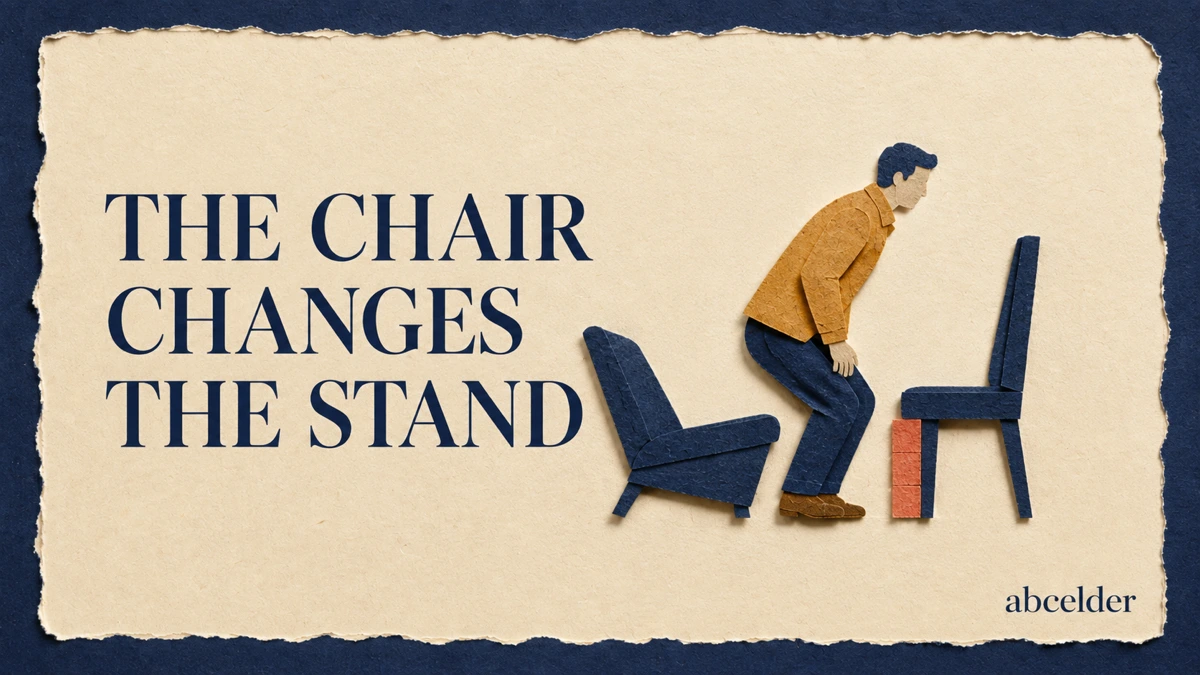
If you have already noticed that one familiar chair is easier to leave, record the difference. Bring those observations to an occupational therapist, physiotherapist or the person's clinician before choosing equipment or changing the chair.
When someone needs two attempts to leave an armchair, the story quickly becomes about the person: weaker legs, less confidence, another sign of decline. The chair is treated as scenery. Biomechanically, it is part of the event.
Standing up means moving the body's centre of mass from a broad base — the seat and both feet — forwards over the feet, then upwards. Lower the starting point, sink the hips backwards or leave no room to bring the feet underneath, and the same body has to travel farther and organise more momentum before the seat lets go.
That is why chair-rise ability is not a fixed property of a person. It is a relationship between the person, the task and the furniture. The distinction matters: a badly matched chair can make help look necessary, while a better fit can preserve an ordinary action. But ‘higher’ is not a universal prescription; a seat that leaves the feet dangling can create a different stability and pressure problem.
Five inches nearly doubled successful rises
A 1993 study began outside the laboratory. Researchers surveyed seating in furniture shops, medical waiting areas, hospitals and nursing homes. The seats they found ranged from 12 to 18 inches high. Living-room seating averaged 15 inches; kitchen chairs averaged 17.3. The rooms where people were expected to relax often started them lower.
The researchers then tested 22 volunteers from nursing-home and community settings at six seat heights, from 17 to 22 inches. Participants who could not stand independently or bear full weight while standing were excluded. As the seat rose in one-inch increments, the proportion of successful rises nearly doubled, reported difficulty fell and participants needed less extreme hip and shoulder movement.
This was a small descriptive study, not a trial of home modification. It did not measure falls, long-term independence or whether a family needed to provide less help. The exact success rate should not be exported to every body or every chair. What it demonstrates directly is narrower and useful: a change of a few inches can move the same person across the boundary between an unsuccessful and a successful stand.
The practical unit is not the catalogue height of an empty chair. It is the occupied starting position: how far the cushion compresses, where the hips settle relative to the knees, whether the feet reach the floor and whether there is space to bring them back before standing.
Comfort and exit can pull in opposite directions
A second controlled study made the furniture itself adjustable. Twenty-nine adults with a mean age of 84 and 21 younger adults rose from configurations that varied seat height relative to knee height, backward seat tilt, backrest recline, foam and armrest position. Lower seats, more backward tilt and more recline increased rise time, body motion and reported difficulty. Under the hardest conditions, a few participants in the older group could not rise, and the age-group difference widened.
The surprise was not simply that low seats were difficult. Some of the features that made exit harder — especially tilt, recline and possibly compressibility — could also feel more comfortable while sitting. A deep armchair may be excellent at receiving the body and poor at returning it to standing. Comfort and functional independence are two design objectives, not synonyms.
The foam result was less certain than the height and tilt findings, and this experiment cannot rank every cushion material. Nor did armrest placement meaningfully change performance in this particular sample, which does not mean armrests are irrelevant for a person who routinely relies on them. The lesson is to test the whole occupied chair rather than infer function from labels such as supportive, ergonomic or easy-rise.
This is what ordinary furniture advice often misses. It asks whether the seat is comfortable, attractive or medically styled. It rarely asks whether the user can leave it without turning a routine transition into a negotiation with gravity.
The chair writes part of the movement
Later biomechanics studies help explain the effect. In one experiment, 52 adults in the older group and 50 younger adults rose from five heights scaled to each person's lower-leg length. Force production and movement speed fell as the seat moved lower; changes became marked once the difference reached about 20% of lower-leg length, roughly 6.2 centimetres in that sample.
A 2023 systematic review of 17 studies, including 343 older and 225 younger adults, found that the older groups generally took longer to rise, used more trunk flexion and postural sway, showed more simultaneous activation around the ankle and knee, and produced less vertical force and momentum during fast stands. The studies varied in speed, foot position, hand use and seat-height setup, so they do not yield one ideal chair specification.
Together, the findings describe a threshold problem. A lower or backward-sinking seat asks for more range, momentum and coordination just when the person may have less reserve in one or more of those systems. The visible extra rocking or pulling is not necessarily poor technique or lack of effort; it may be the strategy that makes the geometry possible.
This does not relocate every difficulty into the furniture. Pain, medication effects, dizziness, neurological change, joint range, fear, fatigue and muscle power can all matter. A sudden or one-sided change deserves assessment. The sharper question is not ‘person or chair?’ but ‘how much is each contributing today?’
Specify the occupied chair
For a family, the most useful first comparison may already be in the room. Which stable chair allows the person to place both feet flat, bring them slightly back, move towards the front and stand using their usual hands, footwear and mobility aid? Which chair makes the hips sink well below the knees, leaves a deep cushion behind the knees or slides when the armrests are loaded? The contrast is more informative than judging a single attempt in isolation.
Do not improvise with loose cushions, unstable blocks or a chair that can tip. Raising a seat can leave the feet unsupported, increase pressure behind the thighs or make sitting down harder. Skin integrity, joint precautions, asymmetry and transfer technique can change what is safe. An occupational therapist or physiotherapist can assess the person in the actual environment and help distinguish a furniture fit problem from a new clinical change.
For product teams, dimensions should describe the chair under use: occupied or compressed seat height, usable depth, seat slope, recline, clearance for foot placement, armrest height and stability under a push. ‘Suitable for seniors’ is not a specification. Neither is a lift mechanism a complete answer if the final height, foot contact or descent is poorly matched.
Public spaces can make the same move without choosing one supposedly universal chair. A small range of stable seat heights and depths gives different bodies a real option. The design question becomes concrete: can the person sit with support and still recover standing without extra help?
A chair observation card
With the person's agreement, record what happens during an ordinary, necessary sit or stand. You do not need to stage a comparison, repeat rises or make a difficult movement harder to complete this card. Copy these prompts for Chair A and, if already familiar, Chair B. “Not observed” is a useful answer.
- 1 Chair and setting: __________. Date and time: __________. The person's own description: __________.
- 2 Seat height and depth, if safely known: __________. What changes when seated (cushion sinks, seat tilts, other or unknown): __________.
- 3 Feet and space beneath the chair — what you noticed: __________. Usual hands, aid or assistance: __________.
- 4 What seemed difficult: __________. Chair movement or wobble already noticed: __________. What remains unknown: __________.
- 5 One question to take forward: Could this chair's height, depth or recline be contributing, and what should we check before changing it?
Keep measurements separate from interpretations. Do not use blocks or loose cushions to test a theory. If a movement is painful, dizzying or unsteady, do not repeat it for the comparison; seek advice about the difficulty. The useful result is a clearer question, not a home test score.
Related family decisions
How much confidence should we place in this?
Confidence is moderate that seat height and backward-sinking geometry change the mechanical demand of standing up. Multiple controlled studies point in the same direction, and the more recent systematic review supports the underlying differences in momentum, trunk strategy and balance control. The classic furniture experiments were small, however, and protocols are not standardised.
Confidence is low to moderate in the near-doubling figure as a general estimate. It came from only 22 selected volunteers tested across 17- to 22-inch seats; people unable to stand independently were excluded. It is a vivid demonstration of a threshold, not a population forecast and not a prescription for a 22-inch chair.
Confidence is low that changing a chair prevents falls, preserves independence over time or reduces care needs. Those outcomes were not tested in the cited height experiments. The proposed comparison is deliberately modest: identify whether chair fit changes one familiar transfer, avoid unstable improvisation and bring the observation into a proper functional assessment when needed.
Sources
- 1. When older adults face the chair-rise challenge: a study of chair height availability and height-modified chair-rise performance — Journal of the American Geriatrics Society, 1993. Survey plus laboratory study of 22 volunteers; successful rises nearly doubled as seat height increased from 17 to 22 inches.
- 2. Chair design affects how older adults rise from a chair — Journal of the American Geriatrics Society, 1996. Controlled comparison of 29 adults with a mean age of 84 and 21 younger adults across height, tilt, recline, foam and armrest configurations.
- 3. Height of chair seat and movement characteristics in sit-to-stand by young and elderly adults — Perceptual and Motor Skills, 2007. Force-platform study using seat heights scaled to lower-leg length in 52 older and 50 younger adults.
- 4. Biomechanical and neuromuscular control characteristics of sit-to-stand transfer in young and older adults — Clinical Biomechanics, 2023 systematic review. Systematic review of 17 studies describing age-group differences in time, trunk strategy, sway, muscle co-activation, force and momentum.
This article is informational and does not replace professional advice.