A strange fact about elder care and healthy longevity
Sometimes the missing member of the care team carries a toolbox
A recommendation can identify the right movement, medicine or routine. It cannot move a shelf within reach or repair the fixture that blocks the goal.
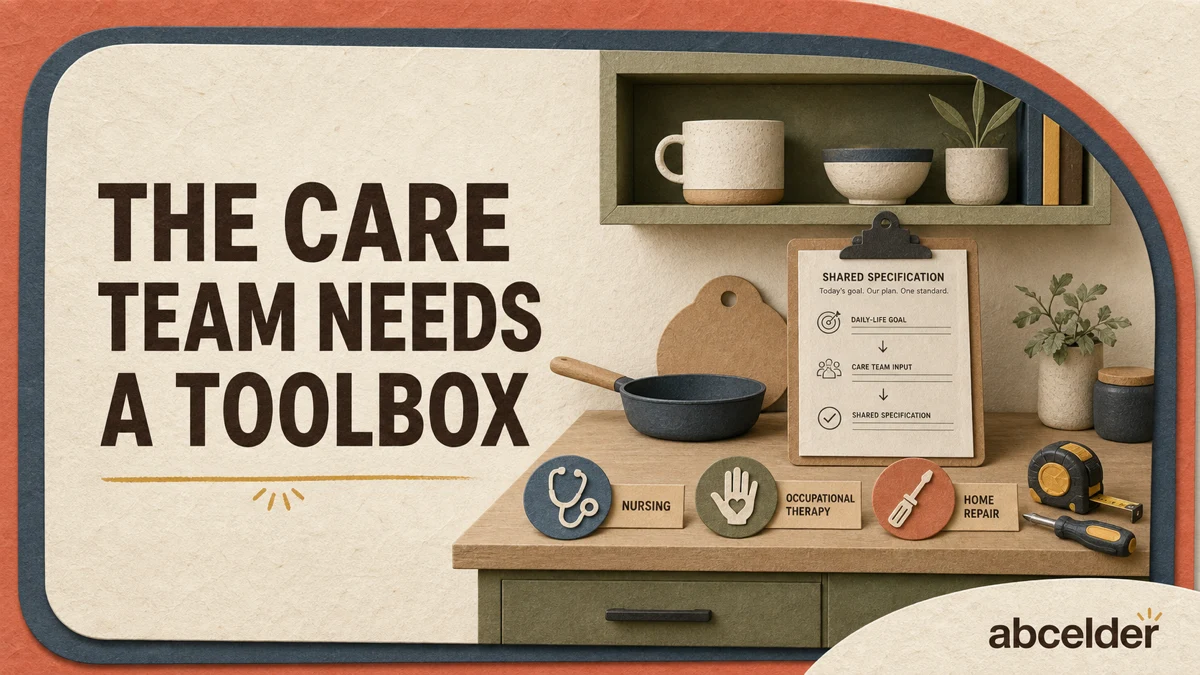
Care teams are usually described with clinical nouns: nurse, physician, therapist. CAPABLE adds a role that sounds almost out of place — a home-repair professional. The surprise disappears when the team stops organising itself around a diagnosis and starts with one action a person wants back.
That action might be taking a shower without help, preparing food instead of waiting for a neighbour, getting dressed with less pain or making tea in one’s own kitchen. Each goal exposes a different system of obstacles. Some belong to strength, pain, medication or technique. Others are screwed to the wall.
One human goal becomes a shared work order
CAPABLE — Community Aging in Place, Advancing Better Living for Elders — is a home-based programme built around goals chosen by the participant. Over five months, a registered nurse can work on pain, medication, depression, balance and communication with primary care. An occupational therapist examines how the person performs the chosen activity and develops strategies with them. A home-repair professional — called a home modifier in the programme — then changes the environment that has to support those strategies.
In the original trial, that could mean stabilising stairs, levelling or repairing flooring, installing equipment or changing another part of the home. The sequence matters. The programme does not begin with a generic catalogue of grab rails. It begins with ‘I want to get downstairs’ or ‘I want to make my own lunch’ and asks what, across person, task and environment, is making that difficult.
This is a more serious idea than adding a tradesperson to a contact list. It turns the environment into part of the intervention rather than the scenery around it.
What the randomised trial found
The 2019 randomised clinical trial included 300 Baltimore residents aged 65 or above, living on a low income and reporting difficulty with at least one basic activity of daily living or two instrumental activities. All were cognitively intact under the study criteria. Participants were assigned either to CAPABLE or to an attention-control group offered up to the same number of one-hour social visits.
At five months, the adjusted basic-ADL disability score in the CAPABLE group was 30% lower than in the control group: relative risk 0.70, with a 95% confidence interval from 0.54 to 0.93. The score captured difficulty or need for help across eight activities, including bathing, dressing, eating, toileting, transferring and walking across a room.
The instrumental-ADL result was smaller and not statistically significant in that trial: a 17% lower score, with a confidence interval that included no difference. By 12 months, the between-group difference in basic ADL was no longer significant. The strongest claim is therefore specific: this person-directed bundle improved self-reported basic daily function at the end of the five-month programme in this population.
The repair sits inside the treatment dose — not the whole result
It would be tempting to turn the headline into ‘a repair professional reduced disability by 30%’. The trial cannot show that. It tested the whole combination: participant-set goals, nursing, occupational therapy, assistive devices, team coordination and home modification. There was no study arm that removed only the repair work.
The intervention model makes the rationale for including the role visible; the trial itself cannot establish that this component was necessary or sufficient. Advice and practice can fail if a physical barrier remains. A well-made modification can also fail if it does not answer the person’s movement, pain, reach or routine. CAPABLE connects the physical change to a goal and to the skills required to use the changed environment.
A 2023 meta-analysis of seven CAPABLE studies found improvements in ADL, IADL and quality-of-life measures compared with controls, but the studies differed substantially and not every outcome had the same evidence base. That strengthens the case for CAPABLE-like programmes, but tells us little about which component did the work.
What a diagnosis-first plan can miss
A clinical plan often ends at the edge of the billable encounter. It can recommend preparing food safely without asking whether the person can reach the pan, open the storage, stand at the counter or carry the finished dish. The remaining gap is then quietly assigned to the family: find a contractor, translate the recommendation and judge whether the work is safe.
A goal-first plan makes that translation visible. The useful unit is not ‘home modification’ in the abstract. It is a chain: the action the person values, the exact point where it breaks, the body or task strategy to practise, and the physical change that makes the strategy usable.
For ABCElder, this is a product principle. A suggestion is incomplete until the family can see which professional owns the next step — and whether the next step is clinical, practical or both.
Turn one goal into a work order
Choose one activity the person would like to do with less effort or help. Observe it once, with permission, and write four lines:
- 1 The goal in the person’s words — not ‘improve independence’, but ‘prepare lunch without waiting for help’.
- 2 The exact moment the activity becomes difficult: reaching, turning, standing, remembering, seeing or carrying.
- 3 What might change through technique, pacing, pain or medication review, and what is physically fixed in the environment.
- 4 Who is qualified to assess each part: for example an occupational therapist, nurse, clinician or repair professional working from a clear specification.
Do not use a generic checklist as the sole basis for safety-critical installation. Placement should be assessed against the person, task and home. The point of the exercise is to bring one precise goal and one observed barrier to the right professionals.
Related family decisions
How much confidence should we place in this?
Confidence in the five-month basic-ADL result is moderate: it comes from a randomised trial with an attention control and masked outcome assessors, although participants could not be blinded and the outcome was self-reported. The population was specific — one US city, low income, mostly women and mostly Black participants, all cognitively intact under the study threshold; apartment residents and people unable to stand were excluded. The exact result should not be assumed for every family or housing system.
Confidence that the repair professional alone produced the effect is low because the components were not separated. Longer-term certainty is also lower: the trial’s between-group ADL advantage was not significant at 12 months. A 2025 trial after hospital discharge found no significant overall ADL advantage, although mobility improved and a prespecified analysis suggested greater benefit among participants with four or more comorbidities. Population and timing matter. The useful conclusion is not ‘book a repair and expect 30%’. It is that daily function can sometimes be changed by treating the person and the home as one system.
Sources
- 1. Effect of a Biobehavioral Environmental Approach on Disability Among Low-Income Older Adults: A Randomized Clinical Trial — JAMA Internal Medicine, 2019. Randomised clinical trial; 300 participants; CAPABLE versus an attention-control programme.
- 2. The effectiveness of CAPABLE as a biobehavioural environmental approach for disability: a systematic review and meta-analysis — Age and Ageing, 2023. Systematic review and meta-analysis of seven studies involving 2,921 participants.
- 3. CAPABLE frequently asked questions — CAPABLE National Center. Current programme description and implementation context.
- 4. CAPABLE for People After Hospitalization: A Randomized Trial — Journal of the American Geriatrics Society, 2025. Randomised trial after hospital discharge; no significant overall ADL advantage, with a mobility signal and prespecified heterogeneity by comorbidity count.
This article is informational and does not replace professional advice.