A strange fact about elder care and healthy longevity
Build the network before anyone calls it care
A ride, a trusted phone number, help with one device and an invitation to tea can be organised while nobody is in crisis.
Family support often becomes visible only when something breaks. A discharge date arrives, driving is no longer possible, a regular driver cancels, or an adult child in another city starts coordinating five phone numbers. At that point every small task carries the weight of an emergency.
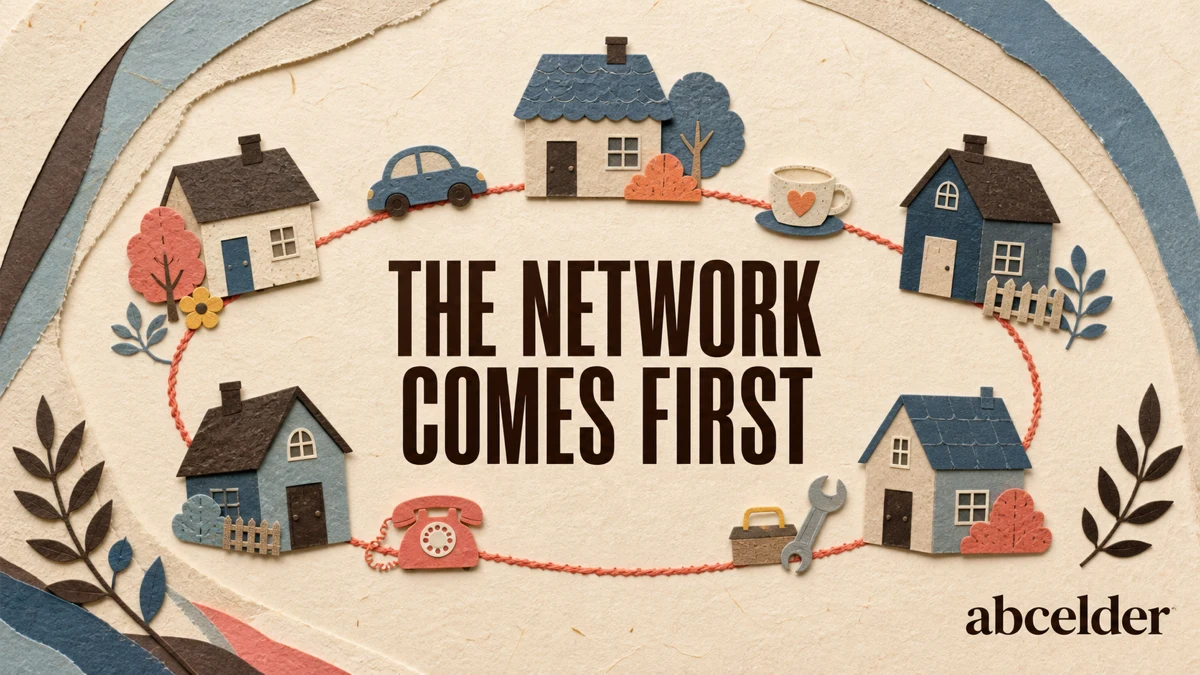
The American Village model tries a different order. It builds a local membership community before high-intensity help is required. Members may organise rides, small household tasks, technology help, social and educational activities, volunteer exchanges and access to vetted services. It looks less like a care provider and more like neighbourhood infrastructure.
The useful part is precisely that it is not a clinic
Villages are grassroots, member-driven organisations, often governed by the people who use them. Structures vary: some are independent nonprofits, some sit inside another organisation, and many combine paid coordination with member-to-member volunteering. Annual fees are common, although subsidy models differ.
The task boundary matters. A Village may arrange a ride, help with a phone, connect a member to a vetted service or create a reason to leave the house. It does not automatically provide medical treatment or hands-on personal care. The model’s value is not replacing professionals. It is making the layer between complete independence and formal care less empty.
That layer contains many ten-minute problems. No single one looks important enough for a service system, yet together they can make everyday life brittle — and turn a family member into the default dispatcher.
What changed over three years
A longitudinal evaluation reported findings from 191 members across seven US Villages during their first 36 months of membership. The researchers reported statistically significant increases in interpersonal contact, participation in groups, the ability to get help with routine activities, the ability to get to places and a sense of belonging.
Those are meaningful outcomes for the model’s actual job. They suggest that people experienced a denser network of practical and social support after joining. But the publication is a short conference abstract. It does not report a comparison group, effect sizes or enough detail to separate the Village from selection, wider life changes or loss to follow-up.
So the honest sentence is not ‘Villages caused better ageing’. It is: across three years, participating members reported improvement in several kinds of accessible support and belonging.
The support signal is promising. The health claim is not.
A related 12-month study of 222 members from seven California Villages found greater confidence in remaining at home, greater perceived social support and less intention to relocate. It did not find broad improvements in health or social connectedness. Most participants had entered in relatively good health and were already well connected, leaving less room for measurable change.
A 2025 research-capacity study still described the evidence on outcomes as nascent and argued that Villages need stronger capacity for community-engaged research. That is useful discipline. A compelling social model should not borrow clinical certainty it has not earned.
For families, the proposition can stand without a health promise: someone familiar who can offer a ride, a neighbour who can collect a parcel, an activity already on the calendar and one trusted coordinator may reduce the number of small problems that have to become family emergencies. This is a plausible operational benefit, not yet a proven medical outcome.
Why ‘before’ changes the design
Trust is hard to manufacture during a crisis. A person who has already shared coffee, offered a skill or accepted a ride is not being introduced to a support network at the same moment they are losing something. Reciprocity can remain visible: today one member fixes a setting on a phone; another recommends a local service; later the balance may change.
The model also gives adult children a different map. Instead of asking one relative to absorb every task, the family can distinguish what belongs to neighbours, what needs a professional, what can be scheduled and what is genuinely urgent.
For ABCElder, this suggests mapping small, bounded tasks and the handoff between neighbour, family and professional — not only listing formal services.
There is an equity problem to solve. The 12-month California sample was 96% White, 70% had a bachelor’s degree or higher, 77% owned their home and most were above a local economic-security threshold. Fees, language, time and neighbourhood capacity may all shape access. Preliminary findings from the 2025 National Village Census report that 86% of fee-charging Villages offer reduced or sliding-scale fees, a useful mitigation but not proof of equitable reach. A network is not inclusive merely because it is local.
Map one ten-minute neighbour task
Do this before anyone needs daily help. Choose one small, non-medical task that repeatedly creates disproportionate family logistics:
- 1 Name the task precisely: one ride to a regular class, collecting a parcel, checking one device setting or adding a recurring event to a calendar.
- 2 List three nearby people or organisations who might do it — and one thing the family or relative could offer in return.
- 3 Set the boundary: what the helper may do, what requires consent each time, and what must go to a qualified professional.
- 4 Test the connection once when nothing is urgent, then ask whether it felt respectful and easy enough to repeat.
This is not a request to turn neighbours into unpaid carers. It is a way to discover whether one tiny piece of social infrastructure can exist before the family is under pressure.
Related family decisions
How much confidence should we place in this?
Confidence that members perceive gains in practical support is low to moderate; confidence in broader gains in contact and belonging is lower. The 36-month abstract reports improvements, while related 12- and 24-month analyses found more consistent gains in perceived access to help but mixed results for contact, group participation and belonging. These studies rely on self-report and do not use randomised or well-matched control groups. The 36-month result is available only as a conference abstract, which limits scrutiny.
Confidence that Village membership improves health, prevents institutionalisation or reduces family-care burden is low. Those outcomes either did not improve broadly in the available studies or have not been tested strongly enough. Treat the model as a promising design for community support — and as a research agenda — rather than a proven health intervention.
Sources
- 1. Fostering Social Capital Through the Village Model — Innovation in Aging, 2017 conference abstract. Conference abstract reporting findings from 191 members across seven Villages during the first 36 months; no comparison group described.
- 2. Do Villages Promote Aging in Place? Results of a Longitudinal Study — Journal of Applied Gerontology, 2018. Twelve-month longitudinal study; 222 members across seven California Villages.
- 3. Healthy Aging Outcomes Research With Villages as Grassroots Community-Based Organizations — The Gerontologist, 2025. Current assessment of the evidence base and a framework for stronger community-engaged outcomes research.
- 4. Creating Age-Friendly Communities Through the Expansion of Villages: Year Three Evaluation Technical Report — University of California, Berkeley, 2015. Detailed 12- and 24-month pre-post findings, including mixed results for contact, group participation and belonging.
- 5. Village model — Village to Village Network. Current description of member-driven Village structures and services.
- 6. 2025 National Village Census — Rutgers Hub for Aging Collaboration. Preliminary organisational census findings, including availability of reduced and sliding-scale membership fees.
This article is informational and does not replace professional advice.